Pharmaceutical marketing is no longer a supporting function – it has become a strategic pillar within the industry. In a landscape where developing a new drug exceeds $2 billion and regulatory pressure continues to grow, the ability to communicate value, train healthcare professionals, and build trust ultimately determines whether innovation reaches real clinical practice.
The sector enters 2026 with strong momentum. According to recent industry reports, 73% of pharma and healthcare professionals describe themselves as highly optimistic, and 60% expect to increase engagement with healthcare professionals (HCPs). But growth comes with a clear expectation: to do things better—more clearly, more efficiently, and more meaningfully.
At Imascono Health, the specialized health division of the tech company Imascono, this shift has been part of our day-to day work for over a decade. Working alongside pharma companies, hospitals, and healthcare professionals, the focus is no longer just on communication, but on how to make science easier to understand, retain, and apply in real-world settings.
Pharmaceutical marketing: making complexity understandable
One of the biggest challenges in pharma remains communication. Products are inherently complex mechanisms of action, clinical evidence, protocols – and the audience is highly specialized. Healthcare professionals don’t need simplification; they need clarity.
This is where interactive marketing is gaining ground. Companies like Bayer and Santen are already investing in digital experiences that allow professionals to explore products in more visual and engaging ways, whether at congresses or through digital platforms. From AI-driven assistants to 3D visualizations and interactive content, the goal is to enable faster, more meaningful conversations.
In this context, solutions developed by Imascono Health focus on turning highly technical content into interactive experiences. The objective is not to make content more “attractive,” but to make it more understandable and usable, reducing the gap between information and action.
Training: learning by doing, not just listening
If there is one area where pharmaceutical marketing is evolving rapidly, it is training. As medical knowledge continues to advance, pharma companies are taking a more active role in supporting continuous education for healthcare professionals.
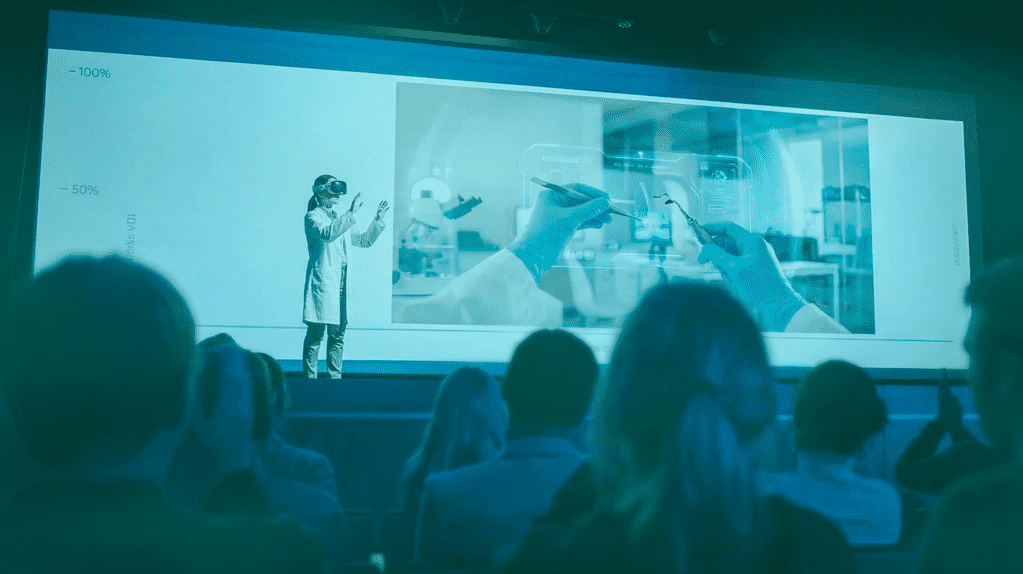
At the same time, formats are shifting. Traditional lecture-based models are being replaced by more immersive, hands-on approaches. Technologies like Virtual Reality allow professionals to practice procedures, repeat processes without risk, and improve knowledge retention.
A strong example is Boehringer Ingelheim, which has implemented VR-based training programs to educate professionals across multiple countries simultaneously. These solutions not only reduce logistical barriers but also ensure consistency and quality in training delivery.
Projects developed with this technology, such as immersive training experiences designed by Imascono Health—are built around a simple idea: learning is more effective when it is experiential. The real transformation is not just technological, but methodological.
Events: from presence to experience
Events remain one of the most powerful channels in pharmaceutical marketing, but their role has fundamentally changed. Being present is no longer enough—brands need to create experiences.
Pharma companies are moving toward event formats where design, storytelling, and technology work together. Organizations like MSD Animal Health and Royal Canin have successfully explored hybrid and virtual formats, expanding reach while enabling real-time engagement measurement.
At the same time, in person events are becoming more immersive. Companies such as Bayer are incorporating augmented reality, gamification, and interactive content into their booths, turning them into spaces of active participation rather than passive observation.
At Imascono Health, this approach translates into experiential events where the goal is not just to attract visitors, but to actively engage them. When healthcare professionals interact, explore, and understand, the connection with the brand becomes significantly stronger.
Applied technology: from trend to real solution
Artificial intelligence, virtual reality, and interactive platforms are no longer emerging technologies they are already available. The real challenge is not access, but application.
Only 22% of companies have successfully scaled AI, which highlights that the issue is not technological, but strategic. In pharmaceutical marketing, this leads to a fundamental question: what real problem are we solving?
Increasingly, the answer lies in tailored solutions. From digital twins of facilities and processes to customized training platforms and intelligent assistants, the value comes from aligning technology with specific needs.
Pharmaceutical marketing is undergoing a profound transformation. Technology is available, budgets are growing, and expectations from healthcare professionals are higher than ever. But success will not come from using more technology—it will come from using it better.
The companies leading this evolution will be those that can explain science more clearly, train professionals more effectively, and create experiences that truly add value. Because in a sector built on trust, marketing is no longer about persuasion it’s about helping people understand.
And in that shift, approaches like those developed by Imascono Health reflect a clear direction for the industry: the future of pharmaceutical marketing is not about adding complexity, but about making innovation more accessible, more practical, and ultimately, more human.