Healthcare in the U.S. is going through a major shift. Growing demand, rising costs, workforce shortages, and changing expectations from both patients and care teams are pushing organizations to rethink how they operate. At the same time, innovation is no longer about “what’s new”—it’s about what truly improves the experience, reduces friction, and supports better decisions.
The numbers reflect the scale of the challenge. U.S. healthcare spending reached $5.3 trillion in 2024, roughly 18% of GDP, and projections show it will continue to rise in the coming years. In a system this large, even small improvements in efficiency, training, or communication can create meaningful impact.
At Imascono Health—the specialized health division of the tech company Imascono we’ve spent more than ten years working alongside pharma companies, hospitals, healthcare professionals, labs, and health brands. Our day-to-day is staying close to real needs: how to train better, how to explain complex science with clarity, how to improve the patient journey, and how to use technology in a way that feels useful and human. With that perspective, here are a few of the health tech trends we see shaping 2026—and how they’re already coming to life through real projects.
1) Experiential events: when a booth becomes something people actually remember
Healthcare events are evolving fast. Being present is no longer enough—brands need to create an experience. Attendees have limited time and are surrounded by competing messages, so what stands out today are spaces that invite interaction, learning, and participation.
That’s why we’re seeing more “phygital” experiences that combine physical design with digital layers: immersive storytelling, gamification, interactive content, and technology that turns visitors into active participants. In projects like an Augmented Reality photocall and game created for Bayer, the goal wasn’t just to “look impressive.” It was about sparking real engagement, encouraging conversations, and creating a moment people genuinely remember.
2) Interactive marketing tools: making complex products easy to understand (without oversimplifying)
Healthcare communication often deals with complexity: mechanisms of action, diagnostic pathways, devices, protocols, and clinical evidence. The challenge isn’t to simplify—it’s to make information clear and usable while staying scientifically accurate.
That’s where interactive tools are becoming essential: smart visualizers, interactive infographics, 3D explainers, and even AI assistants designed to support product communication. The “why” behind this trend is simple: when professionals understand faster, conversations improve, doubts decrease, and communication becomes more effective.
A great example is the Certest Virtual Twin, an interactive digital replica of its industrial environment designed to make a highly specialized biotech operation accessible from anywhere. It wasn’t about showcasing a building—it was about building trust and clarity by helping people understand processes and capabilities in a transparent way.
3) Immersive training: learning by doing, without risk
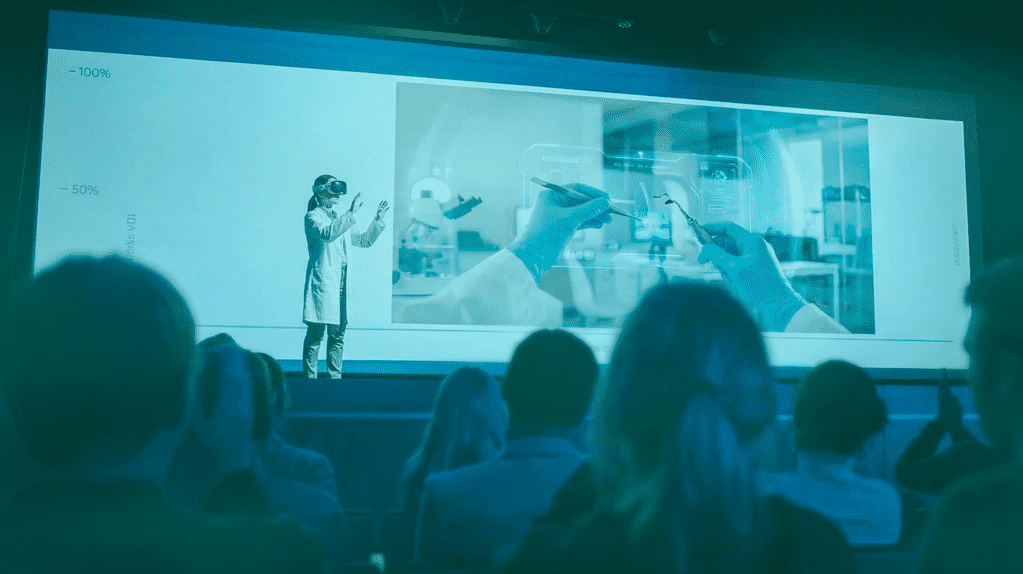
Training in healthcare is becoming harder to scale. Teams are distributed, time is limited, procedures are complex, and consistency matters. That’s why immersive learning—especially through Virtual Reality and simulations—continues to be one of the strongest trends heading into 2026.
The value goes beyond “better visuals.” Immersive training allows repetition without extra cost, practice without risk, and more consistent outcomes across teams. When the goal is technical mastery and confidence, experiential learning makes a real difference.
One example is Virtual Experience Veterinary, a VR training initiative developed for Boehringer Ingelheim in collaboration with the USDA. In the U.S., strict biosecurity regulations limit access to poultry farms and controlled production environments—making it difficult for students to gain hands-on experience during training. This immersive solution recreates a full farm setting, including safety and sanitation protocols, so future veterinary professionals can practice procedures and decision-making in a realistic, controlled environment.
4) Advanced technical content: digital-first, validated, and built for new formats
Scientific content is also evolving. Today, healthcare knowledge is consumed through screens, short training sessions, hybrid formats, and interactive resources. Technical content can’t be “just documentation” anymore—it needs to be digital-first, more visual, and far easier to translate into real understanding.
This is where methodology matters: content built with healthcare expertise, reviewed by specialists, and designed with a clear narrative and engaging formats. The goal isn’t simply to inform—it’s to ensure the knowledge is actually retained and applied.
A strong example is our work with Vivacy, where we produced a technical video that clearly and visually explains how different active ingredients work on the skin—turning complex science into educational, high-impact content that supports product understanding and confidence.
5) Interactive 3D anatomy: visualization as the new standard for learning
Anatomy and procedures are easier to understand when people can see them, explore them, and interact with them. That’s why interactive 3D anatomical models are becoming core tools for education, training, and product demonstration.
These models support faster learning, reduce misunderstandings, and bring clarity to complex topics. They can also be used across many environments—web platforms, presentations, touchscreens, AR/VR experiences, and professional training tools.
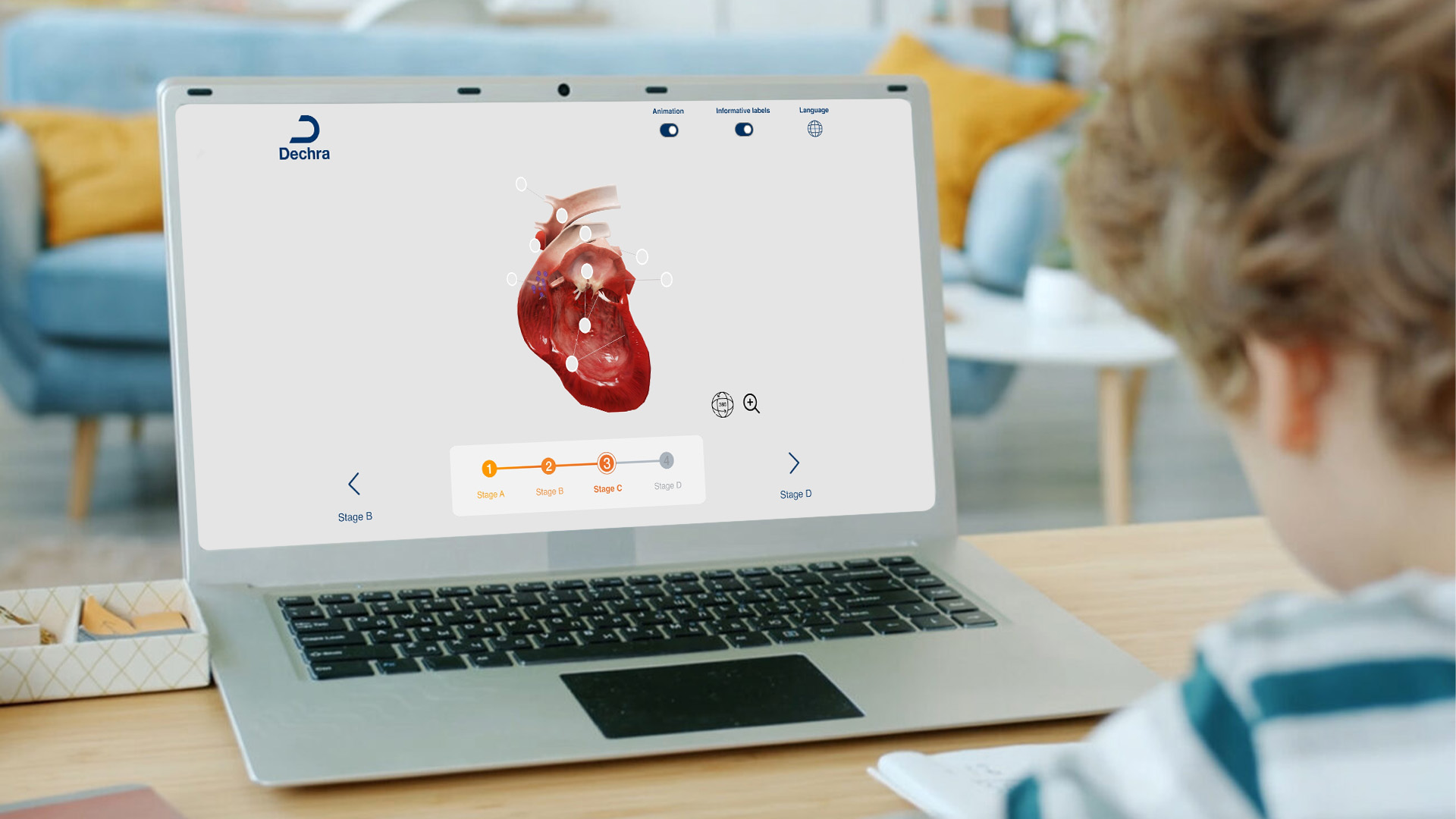
In animal health, the interactive anatomical model developed for Dechra shows exactly why this matters: the goal wasn’t simply to create a “3D asset.” It was to support clinical understanding and provide a more intuitive way to explain internal processes with accuracy and confidence.
6) Tailor-made digital projects: the tech that works is the tech that solves real friction
The most valuable digital transformation doesn’t start with a tool—it starts with a real problem: patient orientation, accessibility, internal communication, onboarding, staff training, process efficiency, or reducing uncertainty at key moments in the journey.
That’s why one of the most important trends for 2026 is the growth of tailor-made projects designed around specific needs. A great example is the Valdebebas Twin, a virtual recreation of the new Blua Sanitas Valdebebas Hospital, designed as an interactive map of the facility.
The purpose behind this kind of digital twin isn’t to create a “virtual tour.” It’s to reduce friction helping patients and visitors understand where to go, what services are available, and how to navigate the space with more confidence. In large healthcare environments, that first experience matters more than most organizations realize.
The next big leap: AI agents for continuous patient support
If we had to highlight one major evolution for 2026, it would be this: AI powered assistants designed to support patients continuously, especially in chronic care. These systems can remember context, guide routines, answer common questions, and escalate to healthcare teams when something needs attention.
This isn’t about replacing clinicians. It’s about expanding capacity, reducing friction, and improving adherence while helping patients feel supported between appointments.
At Imascono, we’ve been developing intelligent agents and conversational avatars, and that foundation allows us to design solutions focused on digital health support and long-term engagement. A good example is Sania, created with Sanitas, built to improve support and orientation within the hospital environment helping patients find answers and complete basic tasks in a faster, more accessible, and more human way.
Sania Sanitas AI assistant
Closing thoughts by Imascono Health
The health tech trends shaping 2026 all have something in common: the initiatives that succeed are the ones that improve real life for patients and professionals. Immersive experiences, hands-on training, digital-first scientific content, 3D visualization, and AI driven support are setting a new standard—more accessible, more scalable, and more human.
If your organization is exploring any of these paths (immersive training, interactive scientific communication, 3D visualization, experiential events, or AI agents) Imascono Health would love to share practical insights and real examples to help you bring an initiative to life in a way that truly makes sense. If this resonates, we’d love to connect.